
Site Development Done on Schedule
Commercial Services in Apex for contractors, developers, and property managers requiring grading, excavation, and infrastructure preparation
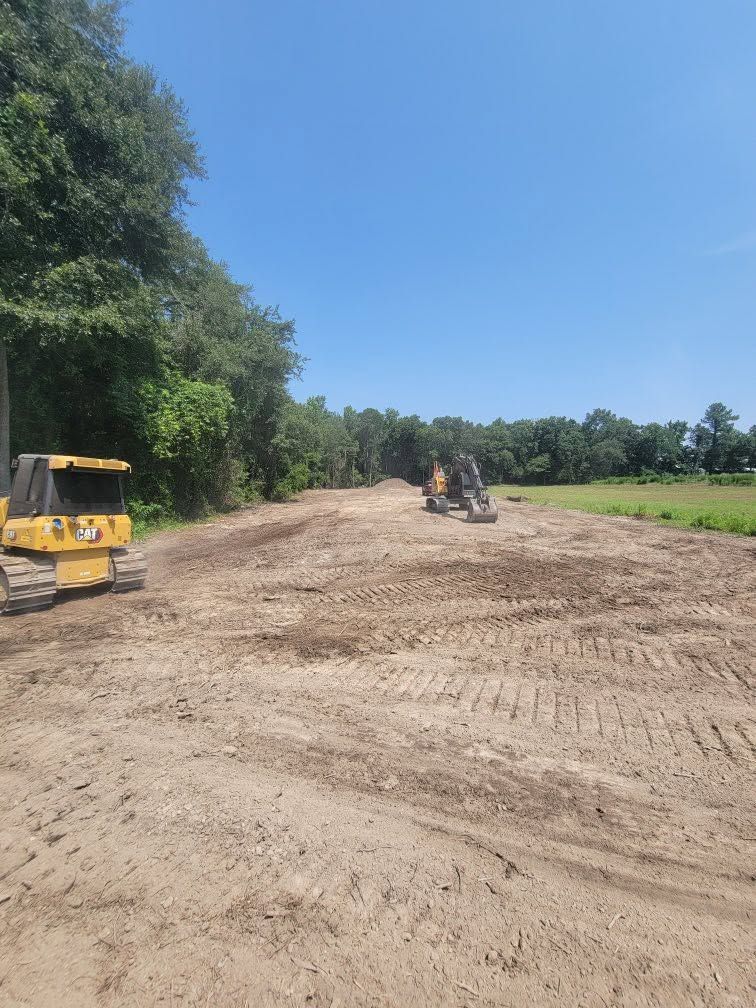
Commercial projects operate on compressed schedules where earthwork delays cascade through every subsequent trade, affecting foundation pours, utility installation, and occupancy deadlines tied to lease agreements or financing terms. Pinesouth Earthworks provides excavation, grading, land clearing, drainage solutions, and infrastructure preparation for commercial properties in Apex, delivering site development work that meets engineering specifications and coordinates with general contractors managing multi-phase construction. The work establishes building pads at precise elevations, routes stormwater according to approved plans, and prepares access roads that support loaded concrete trucks and material deliveries without premature surface failure.
Commercial earthwork involves reading civil engineering plans that specify finished grades, interpreting soil reports that identify bearing capacity and required compaction standards, and coordinating with utility providers to establish trenches for water, sewer, electrical, and data lines at depths and slopes that ensure long-term function. Grading creates positive drainage away from structures while directing runoff to detention basins or municipal systems, preventing standing water that damages pavement and violates stormwater permits. Site clearing removes vegetation and unsuitable soil, exposing stable material capable of supporting structural loads without excessive settlement.
Schedule a project consultation to review site plans and discuss earthwork requirements for your commercial development.
What Commercial Earthwork Involves
Commercial site development begins with surveying existing conditions and comparing them to engineered plans that define cut-and-fill volumes, slope ratios, and finished elevations for parking areas, building footprints, and drainage features. Excavation removes material from high areas and places it in low zones to balance earthwork and minimize hauling costs, though contaminated or unsuitable soil must be removed entirely and replaced with engineered fill. Compaction testing occurs in lifts as fill is placed, verifying that density meets specifications before the next layer is added—failure to achieve proper compaction results in settling that cracks pavement and shifts building foundations after construction is complete.
After grading and excavation are completed to plan specifications, the site supports construction traffic without rutting or erosion, stormwater flows along designed paths rather than ponding in unintended areas, and utility trenches are ready for pipe installation at grades that ensure gravity flow for sewer lines and proper drainage for stormwater systems. Building pads sit at elevations that match architectural drawings, preventing costly rework when foundation contractors arrive. Access roads connect to public streets at approved intersection grades and widths that accommodate fire apparatus and delivery vehicles.
Commercial projects vary from small office expansions and retail pad sites to large mixed-use developments requiring phased earthwork that progresses as permitting and financing allow different sections to begin construction. Coordination with general contractors, civil engineers, and municipal inspectors ensures that earthwork meets code requirements and receives approval before trades depending on finished grades mobilize to the site. Properties with challenging soil conditions, significant elevation changes, or tight access require adjusted equipment selections and sequencing to complete work without impacting adjacent businesses or public infrastructure.
Questions Before Starting Your Project
Commercial earthwork raises technical and logistical questions that affect project schedules, budgets, and coordination among multiple contractors and regulatory agencies.
What documentation is required before commercial earthwork begins?
Projects typically require approved site plans, grading permits, erosion control plans, stormwater management permits, and utility clearance confirming that underground lines are marked. Work cannot proceed until these approvals are secured and posted on-site as required by local regulations.
How does soil type in the Apex area affect commercial grading projects?
Clay soils common in this region require moisture management during grading—working clay when too wet causes it to become plastic and uncompactable, while overly dry clay resists compaction and forms clods. Proper scheduling accounts for weather conditions and may include soil amendments to achieve specified density.
What coordination is needed between earthwork and other site contractors?
Excavation must align with utility installation schedules so trenches remain open only as long as necessary, grading timing affects when pavement base can be placed, and clearing operations must avoid damaging trees designated for preservation in approved landscape plans.
How are changes to site plans handled during construction?
Plan revisions require engineer approval and often amended permits before earthwork proceeds differently than originally designed. Changes affecting drainage patterns or building elevations have cascading impacts on utility grades and pavement design that must be resolved before work continues.
What size and scope of commercial projects can be accommodated?
Capabilities include small tenant improvement sites, multi-building office parks, retail centers, industrial facilities, and institutional campuses. Project approach scales to match the size and complexity, with equipment and crew resources adjusted to meet schedule requirements.
Pinesouth Earthworks delivers commercial earthwork services coordinated with your project schedule and engineered to meet plan specifications. Reach out to discuss grading, excavation, and site development requirements for your commercial property.